


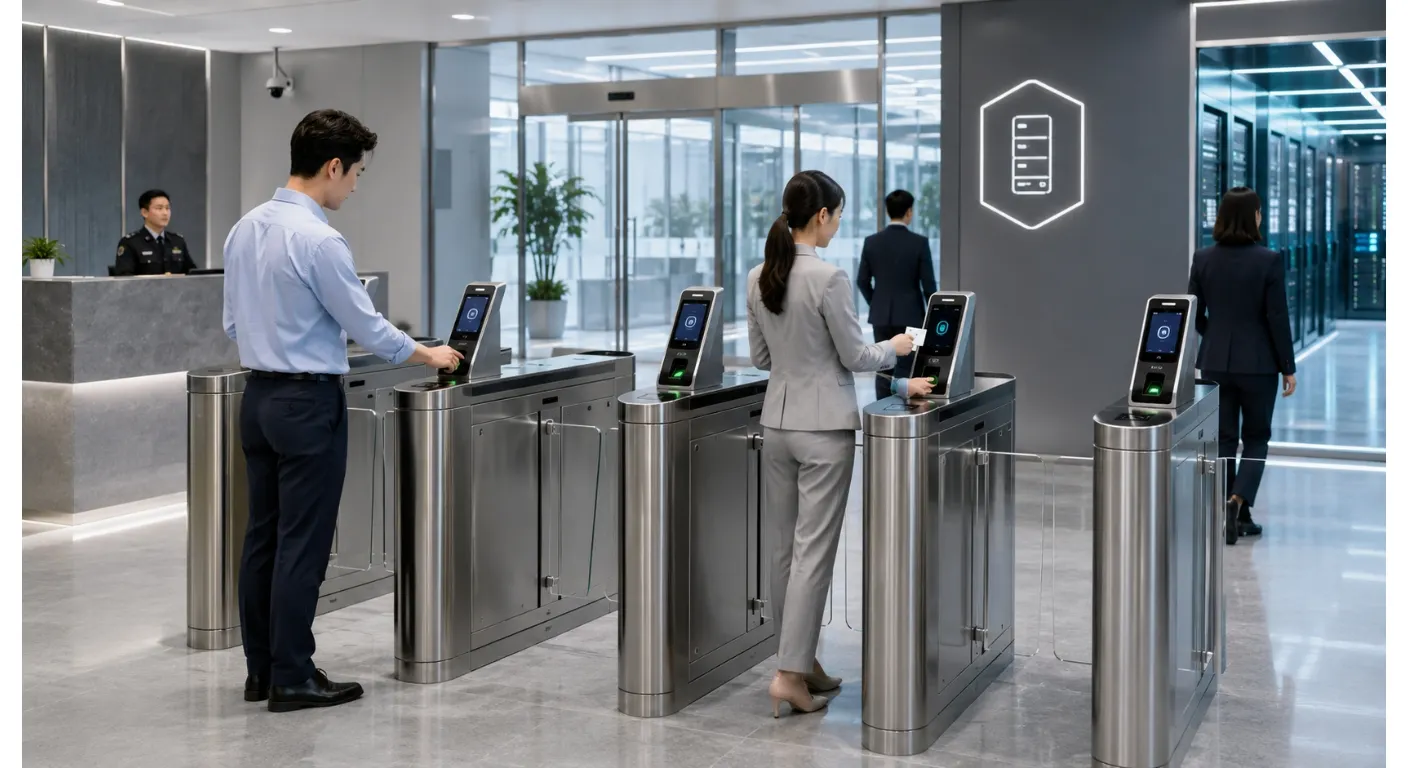
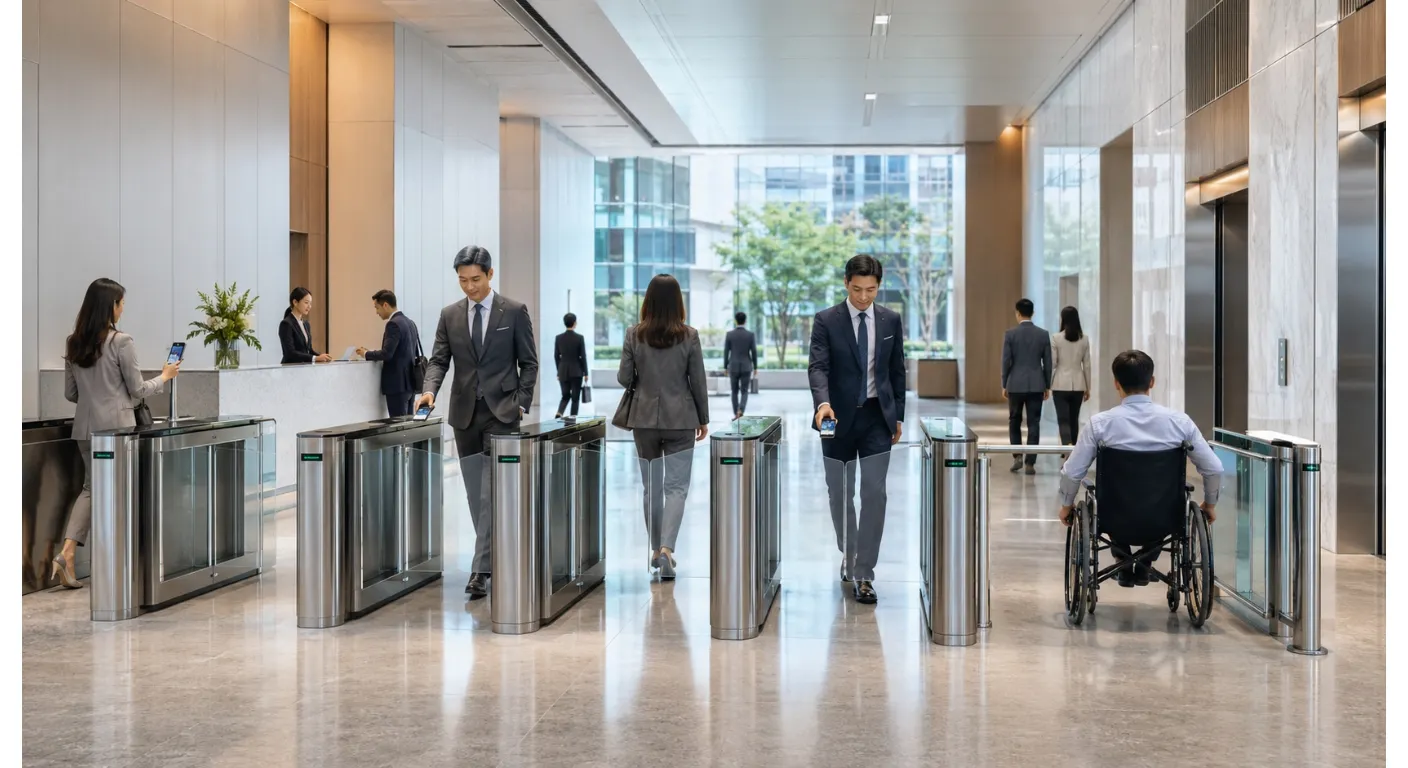
指紋認証スキャナーを備えた生体認証ターンスタイルゲートメーカー
2026-07-16


Choosing a biometric turnstile gates manufacturer with fingerprint scanner technology requires more than attaching a biometric reader to a standard gate. The fingerprint terminal, アクセスコントローラー, turnstile mechanism, pedestrian sensors, management software, ネットワーク, and user-enrollment process must operate as one system.
A reliable solution should verify authorized users accurately, prevent credential sharing, control one-person passage, record access events, and provide a practical alternative when a fingerprint cannot be read. The manufacturer should also explain how biometric data, system interfaces, 緊急時の行動, and long-term maintenance will be managed.
This guide helps security consultants, 施設管理者, data center operators, industrial companies, システムインテグレーター, and procurement teams evaluate biometric turnstile manufacturers and prepare a complete project specification.
Start With the Security Risk, Not the Scanner
Fingerprint turnstiles are most valuable where organizations need stronger identity assurance than a shared card or PIN can provide. Typical applications include data centers, 研究 所, 工場, 企業事務所, 政府施設, 倉庫, and restricted staff areas.
Before choosing equipment, define:
- Who will use the entrance
- Which areas require biometric verification
- Whether fingerprint verification is mandatory or optional
- Expected peak traffic
- Indoor or outdoor installation
- Required passage width
- Existing access-control and attendance platforms
- Visitor and contractor access methods
- Emergency and fallback procedures
- Applicable privacy and employment requirements
Not every lane needs the same authentication level. Employees entering a general office may use cards or mobile credentials, while access to a server room or research area may require a fingerprint plus another credential.
The available biometric turnstile gate solutions should therefore be evaluated as part of a layered security plan rather than as a universal replacement for every access method.
Understand How Fingerprint Turnstile Verification Works
A fingerprint turnstile combines identity verification with physical passage control.
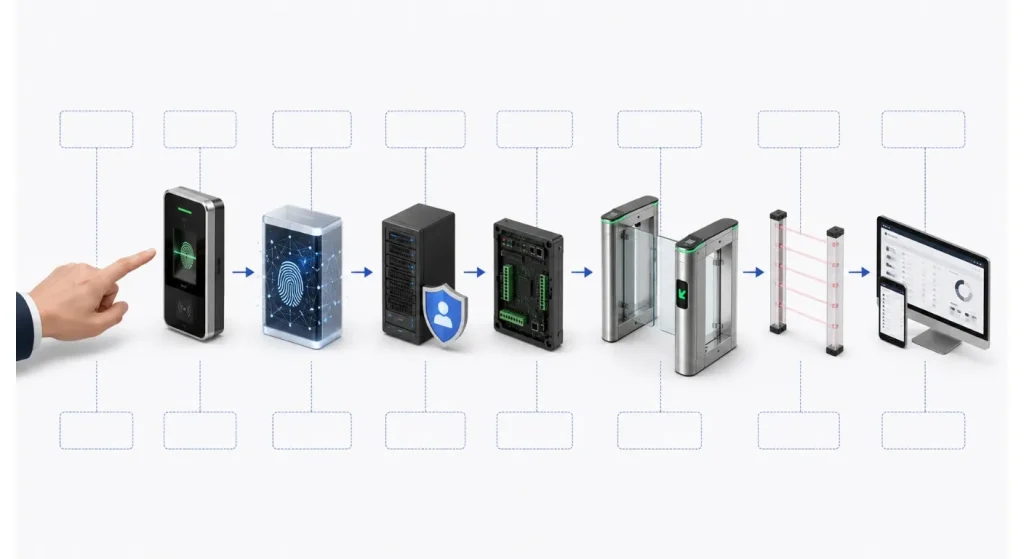
A typical process is:
- A user enrolls one or more fingerprints.
- The biometric system creates a reference template.
- The user presents a finger at the entrance.
- The scanner captures a new sample.
- The matching engine compares the sample with an enrolled template.
- The access platform checks the user’s permission.
- The controller sends an opening command to the turnstile.
- Passage sensors confirm that one person has entered.
- The event is recorded in the management system.
Buyers should confirm whether the project uses 検証 または identification. Verification usually checks a claimed identity, such as an employee number plus a fingerprint. Identification searches a larger database to determine whose fingerprint was presented.
These modes can affect matching time, database design, privacy requirements, and peak-hour performance. The manufacturer and biometric-system provider should document the intended workflow before production.
Evaluate Accuracy Under Real Conditions
Fingerprint recognition is not perfect. アメリカ合衆国. National Institute of Standards and Technology distinguishes between a false match, where the wrong person is accepted, and a false non-match, where an authorized person is rejected. Buyers should review the NIST explanation of biometric error measurement before comparing scanner claims.
Ask the supplier to provide:
- False match and false non-match information
- Test conditions and matching threshold
- Enrollment failure rate
- Average verification time
- Supported database size
- Performance with dry, 濡れた, worn, 汚い, or damaged fingers
- Results with the approved scanner and software version
A statement such as “99.9% accurate” is incomplete unless the test population, threshold, sample quality, and error definition are known.
Construction workers, factory operators, クリーナー, and laboratory staff may have worn fingerprints or may regularly wear gloves. The project should test representative users instead of relying only on office demonstrations.
Provide a Practical Fallback Method
A fingerprint scanner should not become a single point of operational failure. Some authorized users may have temporary injuries, difficult fingerprints, disabilities, or work conditions that make scanning unreliable.
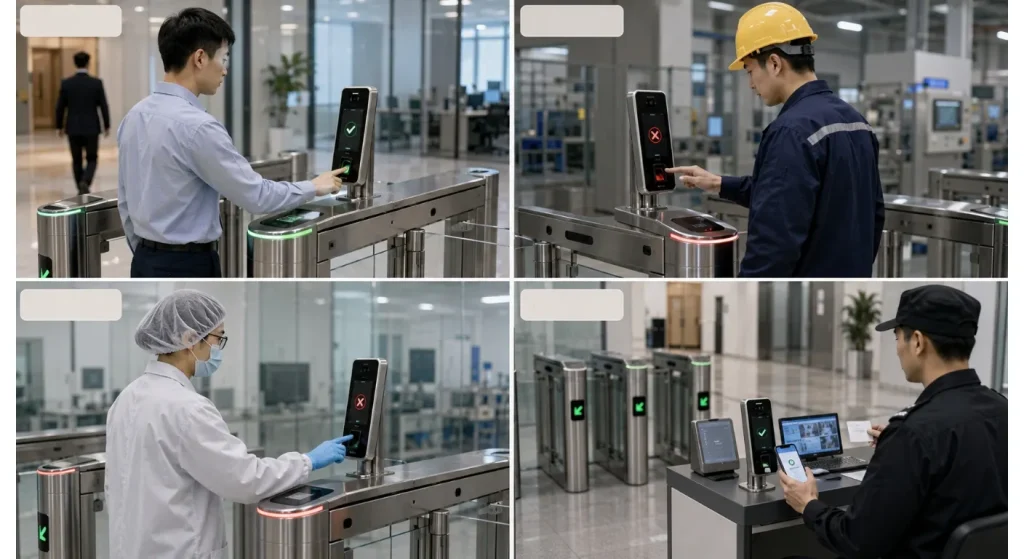
Possible fallback methods include:
- RFID card plus security approval
- Mobile credential
- PIN combined with an employee identifier
- Facial verification where legally and operationally appropriate
- Reception or guard-assisted access
- A separately controlled accessible gate
- Temporary credentials for visitors and contractors
The fallback process should not silently weaken security. Define who can approve an exception, how long temporary access remains valid, and how the event is recorded.
A hybrid configuration using fingerprint, RFID, QR, or mobile credentials can be planned with suitable アクセス制御機器. The correct combination depends on the user group and security policy.
Choose the Gate Type Around the Entrance
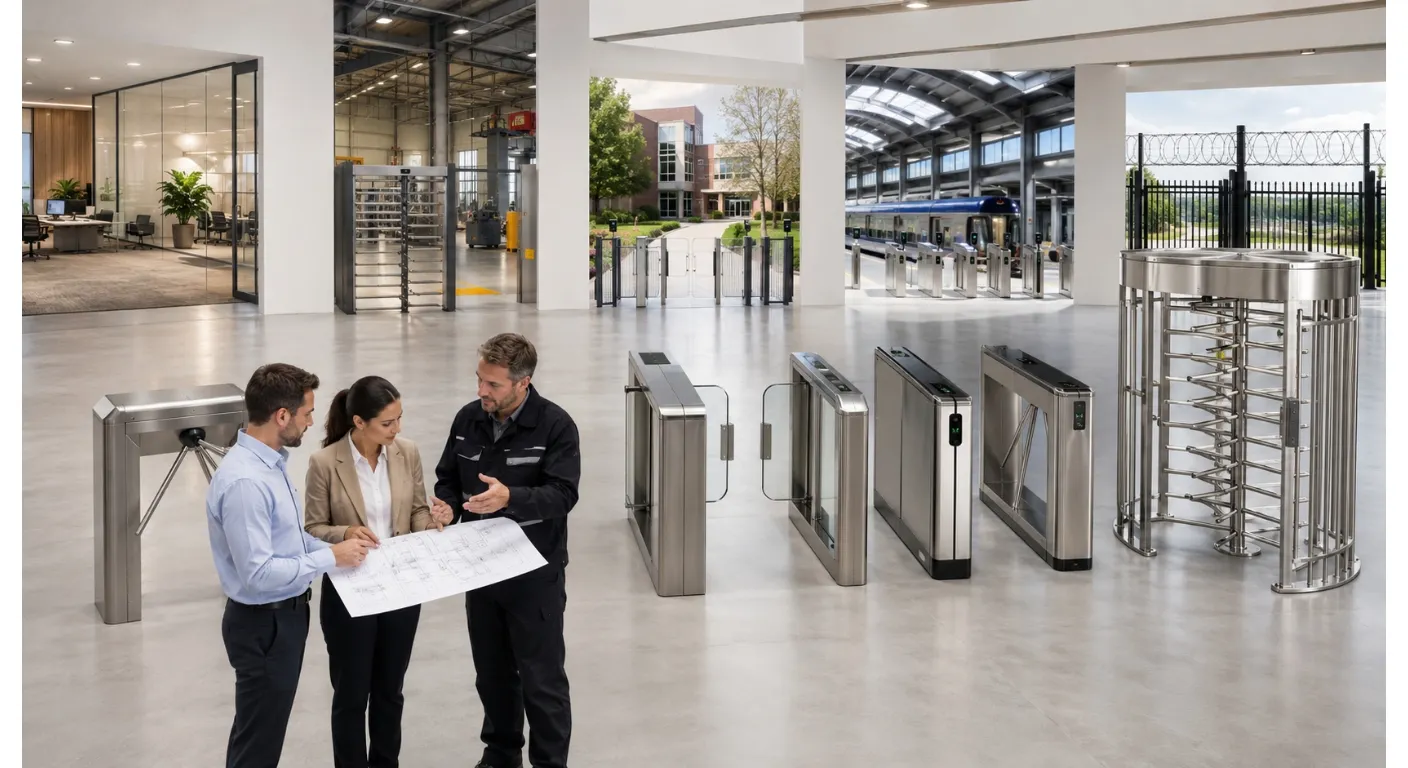
Fingerprint technology can be integrated with several physical gate types.
| ゲートタイプ | Suitable Application | 主な利点 | Point to Verify |
|---|---|---|---|
| 三脚改札機 | Factory and staff entrance | コンパクトで経済的 | Fingerprint queue and narrow passage |
| スイングバリアゲート | オフィス, 病院, or accessible lane | Wider passage | Sensor and closing logic |
| スピードゲート | Corporate lobby or data center | Advanced sensing and appearance | System complexity and cabinet space |
| 全高改札機 | Restricted industrial perimeter | 強力な物理的コントロール | Egress and fingerprint-reader protection |
A 三脚改札ゲート can support controlled employee access, 一方で 生体認証スピードゲート改札機 may suit a premium or higher-throughput indoor entrance.
The gate must match the passage width, セキュリティレベル, 環境, architecture, and expected users. A strong biometric reader cannot correct a poor lane layout or an unsuitable barrier type.
Separate Biometric Security From Passage Security
Fingerprint verification answers, “Is this user authorized?” The turnstile must still answer, “Did exactly one authorized person pass?”
The lane should detect:
- テールゲーティング
- Two people entering together
- 逆方向移動
- A person stopping inside the lane
- Entry without completed verification
- Passage timeout
- Obstruction during barrier closing
- Repeated attempts after rejection
Ask how the scanner decision is linked to the gate controller and sensor logic. The barrier should not remain open longer than necessary, but it must allow enough time for the approved user to pass safely.
For higher-security projects, consider two-factor authentication, anti-passback rules, CCTV event linking, alarm outputs, or security-desk approval. These functions should be tested as one workflow rather than purchased as separate features.
Review Fingerprint Data and Privacy Requirements
Biometric information is more sensitive than a replaceable card number. 展開前, the organization should determine what data is collected, where it is stored, who controls it, how it is protected, and when it is deleted.
聞いてみてください:
- Are raw fingerprint images retained?
- Are biometric templates stored locally or on a server?
- Is data encrypted during storage and transmission?
- Who can enroll, modify, 輸出, or delete users?
- Are administrator actions logged?
- Can former employees be removed promptly?
- What happens if the biometric database is compromised?
- Is a privacy or legal assessment required?
For European projects, consult the European Data Protection Board’s biometric resources and obtain project-specific legal advice before processing biometric data for employee or visitor identification.
The turnstile manufacturer should explain the hardware and integration boundaries, while the organization remains responsible for its data-governance and employment practices.
Verify the Manufacturer’s Integration Capability
A biometric project often involves several parties: the gate manufacturer, fingerprint-terminal supplier, access-control software provider, HR or attendance platform, 設置, and end user.
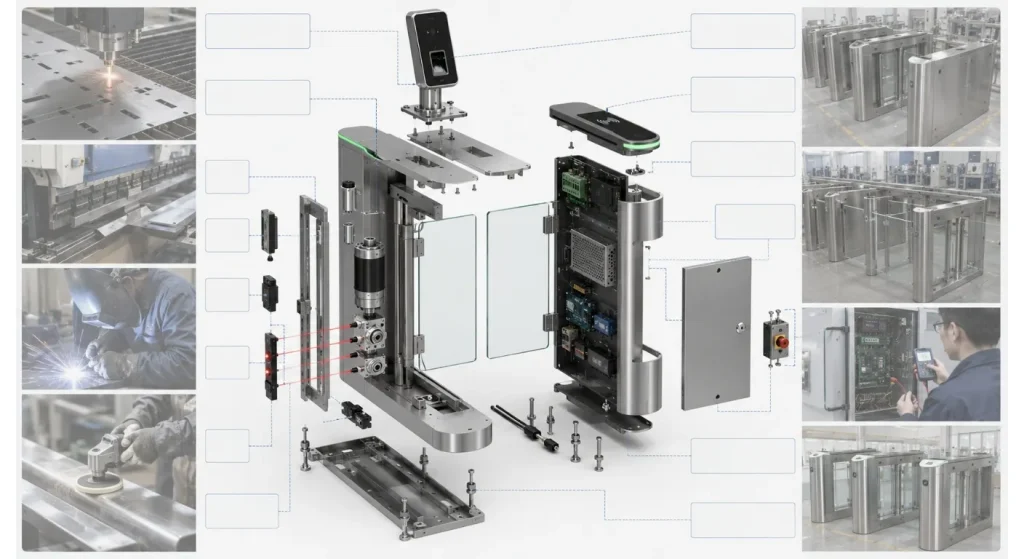
Define responsibility for:
- Fingerprint enrollment
- Biometric matching
- User permission management
- Gate-opening signals
- Attendance records
- Alarm and CCTV integration
- Network configuration
- ソフトウェアアップデート
- Cybersecurity settings
- Technical support
Where API or software integration is required, review the available turnstile gate SDK and API options. Confirm the actual protocol, data fields, 認証方法, event logic, and supported software version.
“Supports fingerprint access” is not enough. The approved scanner, コントローラ, ソフトウェア, and gate must be tested together.
Demand Project-Specific Factory Testing
Factory acceptance testing should reproduce the expected operating conditions before shipment.
Recommended tests include:
- Successful enrollment
- Valid fingerprint access
- Unregistered fingerprint rejection
- Repeated failed attempts
- Poor-quality fingerprint handling
- Fingerprint plus card authentication
- Temporary fallback access
- テールゲート検知
- 逆方向移動
- Network interruption
- Power failure and recovery
- Emergency opening
- Event and attendance recording
For outdoor or industrial projects, also test the reader mounting, protective cover, cable entry, temperature range, dust exposure, and maintenance access.
承認図面のリクエスト, 配線図, インターフェースの説明, テスト記録, ビデオ, シリアルナンバー, software versions, and packaging photos. Any change to the scanner, ファームウェア, コントローラ, or gate logic should trigger a review of the test plan.
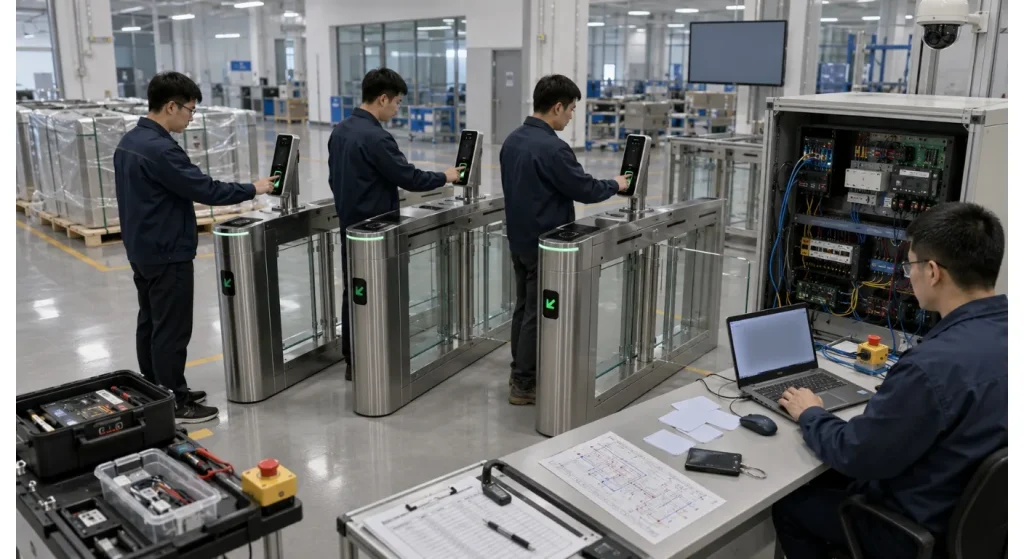
設置とライフサイクルサポートの評価
Fingerprint systems require both mechanical and digital support. Confirm who installs the gate, enrolls users, configures thresholds, connects the network, trains administrators, and handles future software or hardware faults.
レビュー 改札機設置の指導 before completing floor conduits, 電源, ネットワークケーブル, and foundation work.
Also ask about:
- Replacement fingerprint terminals
- Motor and controller availability
- Configuration backup
- Remote diagnosis
- Firmware compatibility
- Administrator training
- Cleaning requirements
- Preventive maintenance
- Warranty claim procedures
The manufacturer’s 保証ポリシー should be reviewed together with the biometric terminal warranty because different components may have different coverage.
Prepare a Complete Biometric Turnstile RFQ
提供:
- Project application and country
- Security objective and restricted areas
- Number and type of users
- ピーク時のトラフィック
- Gate type and lane quantity
- 標準およびアクセス可能な通路幅
- Fingerprint scanner brand or required specifications
- Verification or identification workflow
- Database size
- Multi-factor and fallback requirements
- Access-control, 人事, or attendance platform
- API and network requirements
- Indoor or outdoor conditions
- Privacy and data-storage requirements
- Emergency behavior
- テスティング, 記録, 取り付け, and training scope
- Spare parts and delivery schedule
Send these details through the アイアンマンの連絡先ページ for a project-specific evaluation. Complete requirements allow the manufacturer to identify integration, 能力, プライバシー, and maintenance risks before issuing the final quotation.
結論
A qualified biometric turnstile gates manufacturer with fingerprint scanner capability should deliver more than a gate with an attached reader. The complete project must balance biometric accuracy, passage control, peak-hour performance, fallback access, data protection, システム統合, 緊急時の行動, テスティング, およびライフサイクルサポート.
The best manufacturer will ask how users are enrolled, how fingerprint failures are handled, where data is stored, which systems exchange information, and how the approved configuration will be tested before shipment.
よくある質問
Are Fingerprint Turnstile Gates More Secure Than Card Turnstiles?
Fingerprint verification reduces the risk of shared, ロスト, or transferred cards. Security still depends on scanner quality, system settings, passage sensors, data protection, and fallback procedures.
Can a Fingerprint Turnstile Work With an Existing Access-Control System?
はい, when the fingerprint terminal, コントローラ, protocol, ソフトウェア, and gate-opening logic are compatible. Verify the interface and complete a factory integration test before shipment.
What Happens When an Authorized Fingerprint Cannot Be Read?
The system should use a controlled fallback method such as a card, モバイル認証情報, or security-assisted approval. Every exception should be authorized, 期間限定, and recorded.
Which Turnstile Type Is Best for Fingerprint Access?
Tripod gates suit compact employee entrances, speed or swing gates suit professional indoor areas, and full-height gates suit restricted perimeters. Select the gate according to traffic, 安全, 通路幅, そして環境.
What Information Is Needed for a Biometric Turnstile Quotation?
Provide user numbers, peak traffic, ゲートタイプ, fingerprint workflow, database size, software interfaces, fallback rules, 環境, 試験要件, and project schedule. Include privacy and data-storage requirements where applicable.
