


商業ビル用の自動歩行者用改札ゲート: AIテールゲーティング検出
2026-08-27


An access credential proves that a card, QR code or biometric identity is valid. It does not prove that only one person entered. An Automatic Pedestrian Turnstile Gate for Commercial Buildings closes this security gap by connecting one authorization event with one measured passage.
AI can improve tailgating recognition, but it cannot compensate for poor lane geometry, slow credential processing or incorrectly positioned sensors. 門, detection system and access-control platform must therefore be engineered as one entrance system.
One Valid Credential Does Not Always Mean One Person
Commercial entrances face several different passage risks:
•Tailgating: An unauthorized person follows closely behind an authorized user.
•Side-by-side entry: Two people occupy the detection zone under one authorization.
•Reverse entry: A person moves against the permitted direction.
•Lane intrusion: Someone enters after the barrier begins opening for another user.
These events become harder to distinguish during peak traffic. Shorter pedestrian spacing improves flow but gives the controller less time to separate two people. Backpacks, スーツケース, children and wheelchairs can also resemble an additional body to a poorly tuned system.
An Automatic Pedestrian Turnstile Gate for Commercial Buildings should consequently balance tailgating sensitivity against false alarms. Excessive sensitivity interrupts normal traffic; insufficient sensitivity leaves a usable security gap.
How AI and Sensor Logic Control One-Person Passage
A complete operating cycle contains four linked stages:
- The reader captures an RFID, QR, mobile or biometric credential.
- The access controller issues an authorization signal.
- Infrared sensors and, where required, AI analytics track movement through the lane.
- 門が閉まる, retracts or generates an alarm according to the detected event.
AI may classify human contours, movement direction and abnormal behavior. Infrared sensors still provide fast, deterministic position data for barrier control and anti-pinch protection. Sensor fusion uses both sources to reduce the limitations of either technology.
| Detection method | Best technical use | 主な制限 |
| Infrared array | Fast local tracking and obstruction detection | Extremely close users can be difficult to separate |
| Video AI | Human-shape and behavioral analysis | 照明, occlusion and privacy affect deployment |
| 赤外線 + 宛先 | Cross-validation in higher-risk entrances | Requires more integration and commissioning work |
IRONMAN Intelligent has published face-recognition performance of up to 0.1-second identification and 99.9% accuracy for an AI-enabled gate configuration. しかし, face-identification accuracy is not the same as tailgating-detection accuracy. A project acceptance test must measure tailgating detection, false positives and missed events separately. AI pedestrian gate information
Passage Speed そうあるべきだ Be Calculated as a Complete Cycle
For an Automatic Pedestrian Turnstile Gate for Commercial Buildings, practical throughput depends on:
Credential Time + Controller Latency + AI Processing + Barrier Movement + Pedestrian Clearance
IRONMAN Intelligent commercial configurations use 0.3–0.6-second opening and closing profiles and are rated for up to 50 1分間あたりの人数. あの時 50 1分間あたりの人数, the average arrival interval is only 1.2 お代わり. A slow facial-recognition terminal or remote server can therefore create a queue even when the mechanical gate moves quickly.
Brushless DC and servo motor options address different operating priorities. Brushless DC drives support stable, low-maintenance movement, while servo control provides more precise speed and position profiles for high-frequency lanes. Some commercial configurations are designed for service lives of at least five million operating cycles. IRONMAN Intelligent commercial gate specifications
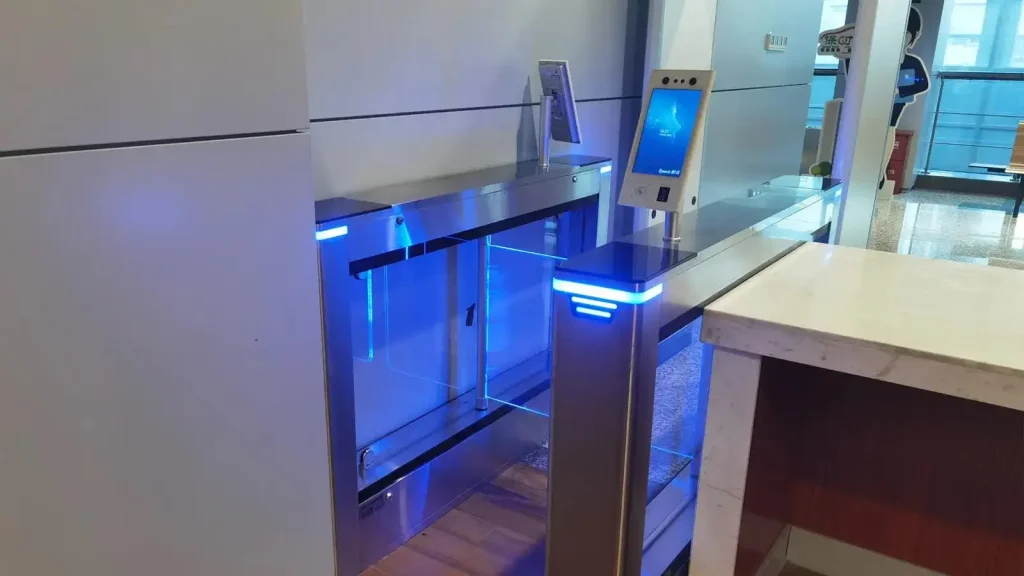
Sensor Coverage and Lane Width そうあるべきだ Be Matched
IRONMAN Intelligent uses different sensor layouts according to the gate structure. Anti-tailgating configurations can employ six pairs of infrared sensors across a single lane, while broader commercial configurations use eight pairs to divide the passage into more detection zones.
More sensor pairs are not automatically better. Detection quality depends on their position, 高さ, signal overlap and control sequence.
Lane width also changes detection behavior:
•A controlled anti-tailgating lane can use a passage width of up to 600 ミリメートル.
•Wider commercial configurations can reach 1,000 MMは車椅子用, luggage or service access.
•Wider lanes require revised sensor zoning because users have more room to pass off-center.
IRONMAN インテリジェントにて, we therefore match the Automatic Pedestrian Turnstile Gate for Commercial Buildings to both peak flow and user profile rather than applying one sensor threshold to every lane.
Structural Data Should Follow the Installation Environment
IRONMAN Intelligent manufactures anti-tailgating housings in 304 stainless steel for corrosion resistance and frequent public use. Compact commercial structures are also available in 1.5 mm SGCC鋼, allowing slim 120 mm cabinet profiles while maintaining structural rigidity.
Material and enclosure protection must be considered together. Commercial configurations cover:
•Operating temperatures from −20°C to +60°C;
•IP54 protection for indoor installation;
•Optional IP65 construction for sheltered semi-outdoor sites;
•AC 100–240 V, 50/60 Hz input with a 24 V DC control system.
IP65 does not remove the need for overhead shelter, drainage and protection against direct water entry. Exterior material, コーティング, internal sealing and site exposure must be evaluated as a system.
統合 そうあるべきだ Transfer Events, Not Only Open Commands
An Automatic Pedestrian Turnstile Gate for Commercial Buildings should exchange more than a dry-contact opening signal. The system must define how it reports:
•Passage completion;
•Tailgating and reverse entry;
•Obstruction or anti-pinch activation;
•Forced entry;
•Emergency release;
•Controller or sensor faults.
IRONMAN Intelligent supports RS485, TCP/IP, Wiegand and dry-contact integration across commercial configurations, together with RFID, QR, facial recognition and mobile access. The final protocol should be confirmed for the selected gate and third-party platform.
Installation and Maintenance Preserve Detection Accuracy
For optimal level sensor behavior, cabinets must be placed evenly on level floors. High-voltage lines and communication cables must not be in close proximity to each other. また, each lane on a multi-lane system requires evenly spaced cabinets to avoid cross-lane detection.
Site acceptance testing must reflect real world behavior, such as cases of close following, side-by-side passage, bags being carried in the lanes, wheelchairs in the lanes, stopping and moving backwards in the lanes. Three to six month maintenance will include sensor cleaning, checking barrier position, checking power and the communication connection.
Confirmation of Safety and Production Evidence
The Buyer should examine the applicability of EN 17352 to powered pedestrian entrance-control equipment, ISO 12100 risk evaluation, ISO 13849-1 safety-related control functions, local fire regulations and accessibility. さらに, installations of AI video equipment require a documented data retention and privacy policy.
ISO 9001-certified IRONMAN Intelligent offers gate automation with a multi-phase inspection system from raw material to final testing. IRONMAN Intelligent offers several manufacturing processes such as rolling, 溶接, stamping and coating. The quality control and manufacturing data should be captured through configuration-specific inspection, endurance testing and compliance documentation while procurement process is in progress.
Safety testing of Commercial Building Automatic Pedestrian Turnstile Gate should focus on the results of tests rather than broad AI claims. IRONMAN Intelligent requests that you provide your building layout, ピークフロー, access control methodology and the width of the lanes. We have configurations available for your testing that are ready to be installed on your project.
よくある質問
Q1. What Types of Commercial Turnstile Gates Does IRONMAN Intelligent Offer?
IRONMAN Intelligent manufactures speed gates, スイングバリア, フラップバリア, 三脚回転式改札, スライドゲート, full-height turnstiles and other pedestrian entrance systems. The appropriate structure is selected according to security level, 交通の流れ, available space and accessibility requirements.
Q2. How Does IRONMAN Intelligent Detect Tailgating?
IRONMAN Intelligent configurations use infrared sensor arrays and control logic to track authorized passage, reverse movement and abnormal entry. AI or video analytics can be integrated when a project requires additional human-shape or behavioral analysis.
Q3. What Is the Throughput of an IRONMAN Intelligent Commercial Turnstile?
Selected commercial configurations are rated for up to 50 1分間あたりの人数, with barrier opening and closing times of approximately 0.3–0.6 seconds. Actual throughput depends on credential-reading speed, AI latency, user spacing and site settings.
Q4. Can IRONMAN Intelligent Customize the Passage Width?
はい. Controlled anti-tailgating lanes can be configured with passage widths up to 600 ミリメートル, while wider commercial configurations can reach 1,000 ミリメートル. Wider lanes may be used for wheelchairs, luggage and service access but require adjusted sensor zoning.
Q5. Which Authentication Methods Can Be Integrated?
An Automatic Pedestrian Turnstile Gate for Commercial Buildings from IRONMAN Intelligent can support RFID cards, QRコード, 顔認識, fingerprint readers and mobile credentials. Integration options include RS485, TCP/IP, Wiegand and dry-contact interfaces, depending on the configuration.
